
How to Search Criminal Dockets
Open the Taylor County Odyssey Public Access landing and pick Criminal Case Records. Bring a cause number if you have one. Searching without it can trigger a $5 research fee, which is why the county stresses that identifier. The search form's exact field layout varies, so follow what loads on your screen.
If the portal stalls on you, phone the District Clerk Criminal Department for a felony docket or the County Clerk misdemeanor office for a Class A or B case. re:SearchTX offers another possible layer. It does not replace the local clerk, and its criminal coverage may be thin.
- Identify the offense level and issuing court from the notice, bond paper, or cause number.
- Choose Criminal Case Records and search by cause number first.
- Match the court, filing date, status, and charge.
- Read events through the newest setting and disposition.
- Ask the clerk for the filed order or certified copy when needed.
Taylor Odyssey Criminal Records
The official Taylor Odyssey source shows why choosing a record location matters.
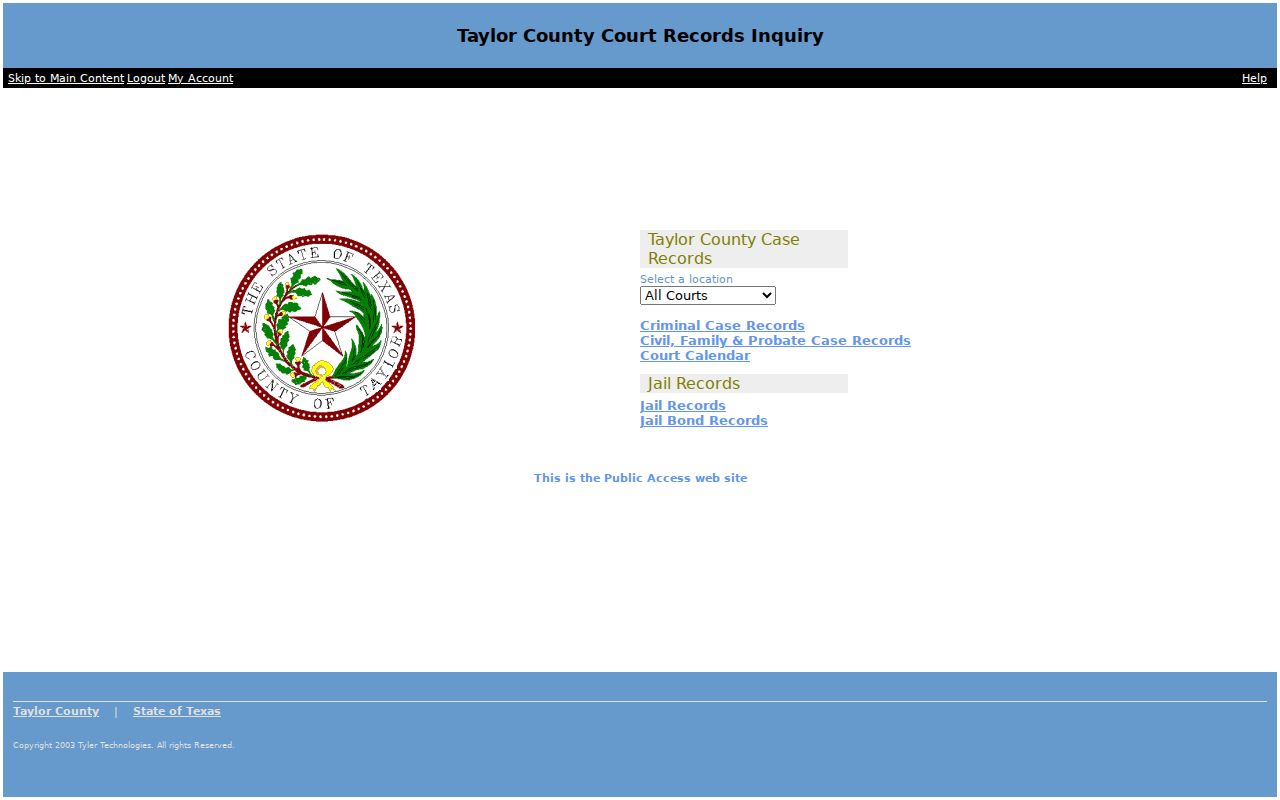
The Odyssey landing splits criminal cases away from civil, family, probate, calendar, jail, and bond records. Keep those buckets straight. A jail listing is not the criminal docket. A bond hit is not an outcome either. When a known felony will not surface, try a desktop browser. Double-check the court, and call the District Clerk. A blank result proves nothing about whether a case exists.
Key point: Start a Taylor County criminal docket search with court custody, not a broad name search.
What a Criminal Docket Shows
Think of a Taylor County criminal docket as a register in time order. It names the cause, the court, the charge level, the public parties, the settings, the motions, and the rulings. It ends with the disposition. Bond, warrant, payment, probation, and post-judgment events can appear too. Context matters when you read them. An indictment only alleges an offense, and a bond entry only covers release or security. Neither one decides guilt.
| Cause number | The clerk's unique case key and the best route to a precise search. |
|---|---|
| Court | The district court or County Court at Law assigned to the matter. |
| Charge | The alleged offense and level, subject to later amendment. |
| Register events | Filings, hearings, motions, orders, pleas, and trial events in date order. |
| Setting | The current date, time, place, and purpose when published. |
| Disposition | The recorded result, such as dismissal, plea, conviction, or deferred adjudication. |
One caution. A docket summary is not the filed indictment, the signed order, or the judgment, and those papers may take a paid clerk copy.
Taylor Felony Copy Requests
The Taylor criminal-records page displays the local written-request and copy rules.
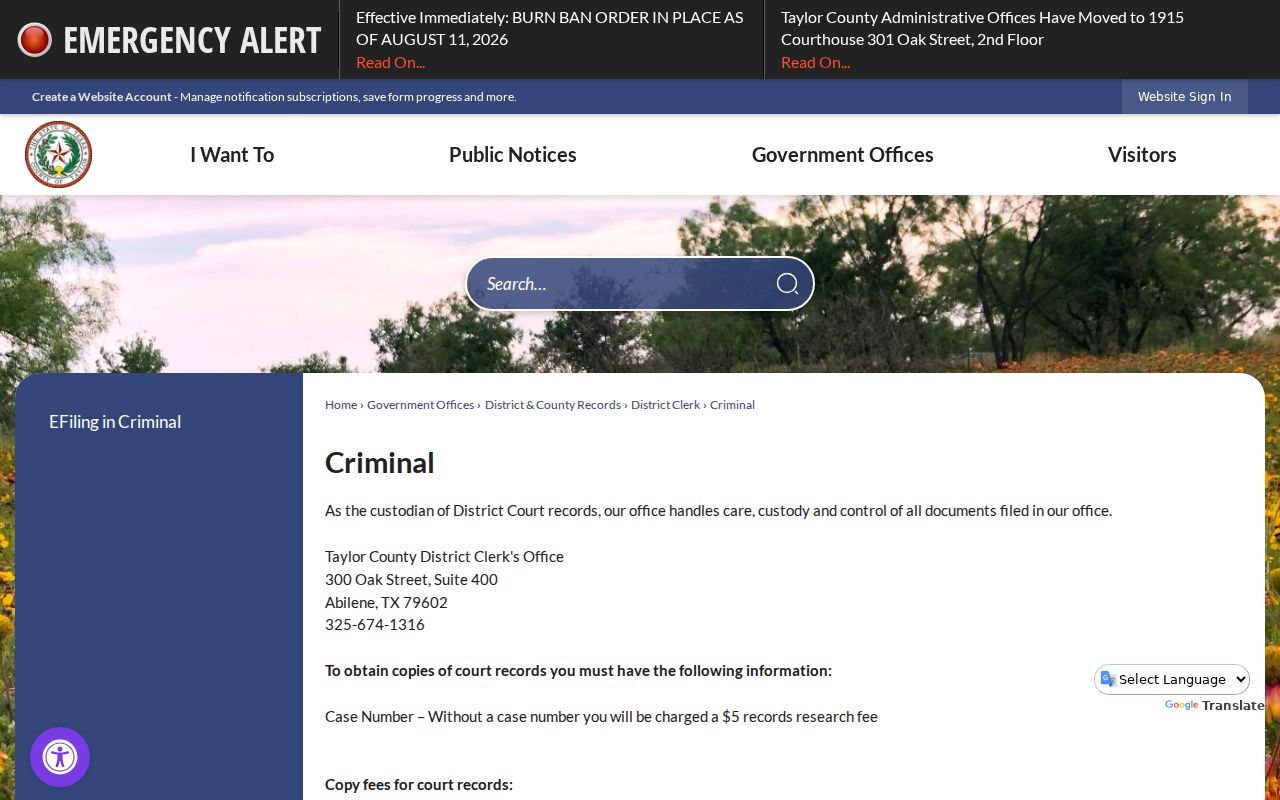
The District Clerk takes felony copy requests in person or by mail. Address them to Criminal Felony Court Records. The counter sits at 300 Oak Street, Suite 400, Abilene, Texas 79602. The phone is (325) 674-1316. Certified and non-certified copies both run $1 per page. Payment in full comes before mailing. The office lists no separate certification surcharge, so confirm the invoice anyway.
Name the cause number and the document you want. No number? Then give the clerk enough public case facts to find the file. Budget for the $5 research fee. Ask to inspect the docket when the event history is all you need. Order a copy when the actual filing matters.
Stages on a Criminal Docket
A docket grows as the case moves. The charging instrument opens the court record, then arraignment records the formal response. Pretrial settings handle discovery, motions, plea talks, and scheduling. A plea or trial can produce a disposition, with sentencing and later entries to follow. Not every case walks through every step.
Docket flow: Filing → Arraignment → Pretrial → Plea or Trial → Disposition → Sentencing
Local timing clues help. District rules put arraignment about two weeks after indictment, and County Court at Law practice sets a Thursday 9:00 a.m. release-arraignment for qualifying misdemeanors. Trust the newest notice, since any date can be reset.
- Arraignment
- The hearing where the charge and plea are addressed.
- Reset
- A new setting that moves an earlier date.
- Nolle prosequi
- A formal decision not to continue a charge at that time.
- Deferred adjudication
- An outcome that postpones a finding while stated terms are completed.
Taylor Criminal Court Routing
No single Taylor County office holds every criminal docket. The 42nd, 104th, and 350th District Courts hear felonies. The District Clerk keeps those records. Class A and B misdemeanors go to the County Clerk and the County Courts at Law. Fine-only Class C cases can stay with a Justice of the Peace instead. A municipal court may hold them too.
| Level | Taylor court | Custodian |
|---|---|---|
| Felony | 42nd, 104th, or 350th District Court | District Clerk |
| Class A/B misdemeanor | County Court at Law No. 1 or No. 2 | County Clerk |
| Class C/traffic | JP or issuing municipal court | That lower court |
A surname rule shapes misdemeanor filing in Taylor. Names from A through K generally go to Court No. 1, and L through Z to Court No. 2. Verify the assignment anyway, because the clerk can reassign a cause.
Which Court Holds Criminal Dockets
Per the district directory and local rules, the 42nd sits in Suite 401, the 104th in Suite 402, and the 350th in Suite 404, all at 300 Oak Street. Their published phones are (325) 674-1314, (325) 674-1313, and (325) 674-1242. The District Clerk occupies Suite 400. Hours are weekdays 8:00 a.m. to 5:00 p.m., with a noon to 1:00 p.m. closure.
County Court at Law No. 1 is in Suite 500 at (325) 674-1323. Court No. 2 is in Suite 501 at (325) 674-1208. Call the court coordinator for a setting. Call the clerk for a docket or a copy. Five JP precinct places and the local municipal courts keep their own lower-level records. Route those cases by the court named on the citation.
Taylor Resets and Outcomes
Never stop reading at the first hearing date. A reset just moves a setting; it does not dismiss a charge. A warrant, a bond record, or a pretrial entry does not settle the outcome either. Find a clear disposition first, then read the sentencing or post-judgment events that follow.
Taylor's pre-trial diversion program shows why process is not result. The District Attorney and supervision department weigh these case by case. Some first-time misdemeanors qualify. So do felonies up to the third degree. The official description uses a one-year completion target with possible dismissal. Diversion is not a search portal of its own. Do not infer it from a vague docket result.
If a setting looks wrong: keep the cause number ready and confirm the newest date with the assigned court coordinator before appearing.
Public Access and Sealed Criminal Dockets
Texas treats most adult criminal dockets as public, and Taylor County is no exception. Still, the law shields certain records. Juvenile files stay out of a public search. So do sealed cases, expunged matters, and orders of nondisclosure. So does material sitting with a municipal court, a JP court, or the County Clerk system. Some ranges never go online. When a Taylor County case lookup comes back empty, any of these could explain it.
A records request works best when you name the case. Name the court and the document you want. Adjudicative case records answer to court and clerk rules. Administrative judicial records may instead follow Rule 12. Non-judicial county information may fall under the Texas Public Information Act. Route each request to the office that actually holds the record.
Key Rules:
Family Code Chapter 58 limits juvenile-record access.
Code of Criminal Procedure Chapter 55A governs expunction.
Rule 9.9 identifies sensitive data for redaction.
Judicial Branch access policy explains Rule 12 and public-information routing.
Handle what you find with care. Do not copy birth dates, home addresses, minor names, government identifiers, or financial data from a docket. Confirm your reading with the originating clerk and the signed document itself.
Taylor Criminal Docket Nondisclosure
Nondisclosure is not dismissal, and it is not expunction. The three are often confused. Taylor County's official nondisclosure page points readers to Office of Court Administration forms. It also notes that the County Clerk cannot advise on eligibility or prepare a petition. Once an order is signed, it can change what a public search reveals.
Read access rules from the signed order. Use current law, not guesswork. Clerk staff will identify forms, filing channels, fees, and public records for you. They will not give legal advice on what an order does.
Taylor Criminal Docket Settings
A setting tells you what the court plans to hear that day. Nothing more. It promises neither a trial nor any final result. A Taylor criminal docket might list arraignment, pretrial, plea, motion, trial, or sentencing settings.
Check the newest entry. Match it against the latest notice you received. If a reset shows up later, call the assigned coordinator. Start with the Taylor County court calendar. Then let court staff confirm any change.
Taylor Criminal Docket Documents
A register entry and a filed document answer different questions. The entry proves an indictment, motion, order, or judgment was filed. The document itself holds the terms. Ask for the named item. Do not trust a short label to capture every ruling or condition.
Browsing the register may cost nothing. Copies are another matter. The District Clerk charges by the page. Certification applies to the official copy, not to whether an online summary seems complete.