
How to Search Civil Dockets
Begin at the Taylor County Odyssey Public Access portal. Choose Civil, Family & Probate Case Records. A cause number from a notice, citation, order, or prior filing is the best starting point. It narrows the docket search. It also sidesteps the $5 clerk research fee that may apply when the number is missing. Before reading the register, confirm the court, case type, filing date, status, and style.
For district civil and family court records, use the District Clerk civil-search route. County civil and probate matters may belong to the County Clerk. They may belong to a County Court at Law instead. Justice civil, debt, small-claims, and eviction dockets stay with the proper Justice of the Peace. re:SearchTX can be checked for eligible integrated records. Even so, the local clerk remains the source for the court file.
- Identify whether the case is district, county, probate, family, or justice civil.
- Choose the matching Odyssey record location and search by cause number first.
- Match the case type, court, filing date, and public party information.
- Read service, pleadings, settings, rulings, and disposition as separate events.
- Request the signed or certified document from the proper clerk when needed.
Taylor Civil Search Since 1994
The official Taylor County civil-search page marks a firm online coverage boundary.
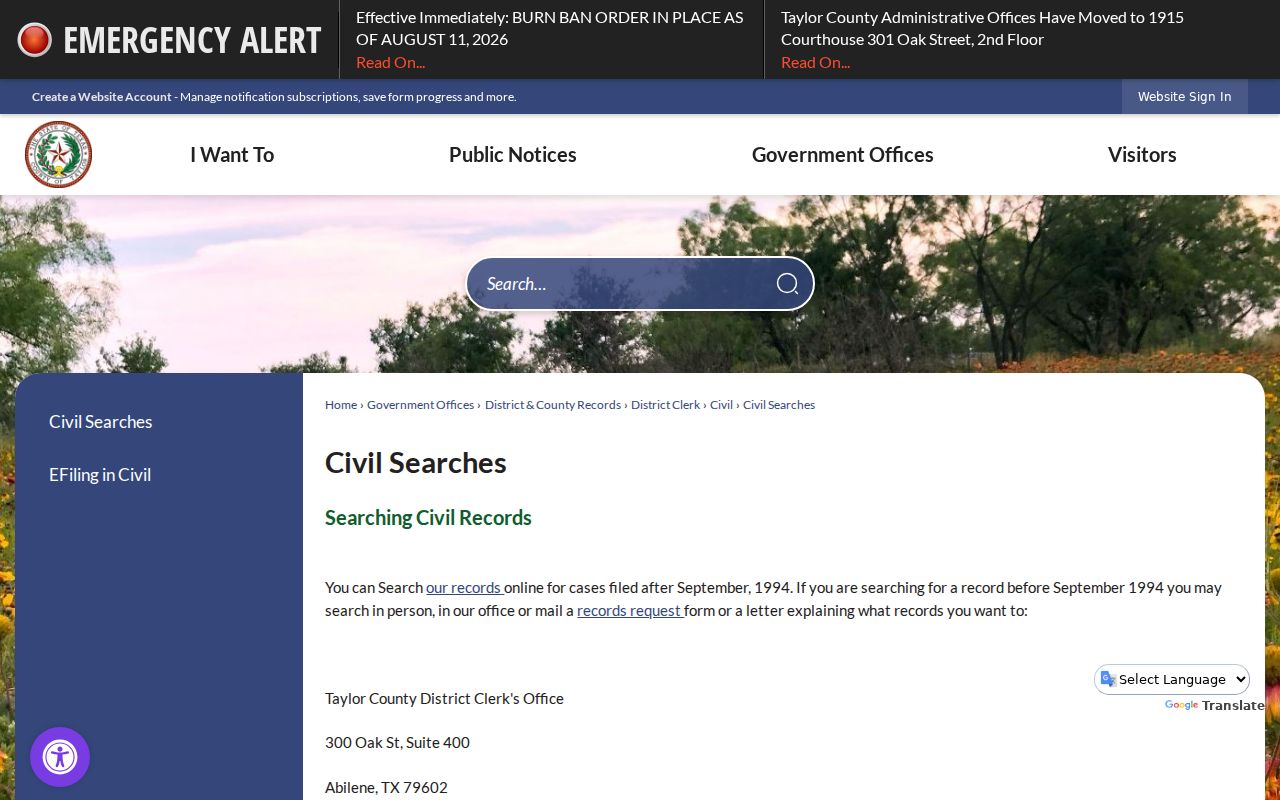
District civil records filed after September 1994 can be searched online. Earlier Taylor County files need an in-person search. They can also be reached through a civil search form or letter sent to the District Clerk. That cutoff is a technology boundary. It is not proof the older files do not exist. Repeating an online name search will not pull a pre-September 1994 index into the portal.
Older case: Send the known cause number, party names, filing year, and requested document to the Civil Records Division.
What a Civil Docket Shows
A Taylor County civil docket tracks procedure, not argument. The first filing opens the matter. Citation and service entries show whether process was issued and returned, and later answers, counterclaims, motions, notices, orders, and settings build the chronology. The ending may be a judgment, agreed order, nonsuit, dismissal for want of prosecution, default, or an appeal event.
| Cause number | The unique case key used by the court and clerk. |
|---|---|
| Case style | The public caption identifying the sides of the civil matter. |
| Case type | The category, such as damages, tax, family, probate, or another civil class. |
| Service | Citation issuance, return, waiver, or other public service event. |
| Filings | Petitions, answers, motions, notices, and orders in chronological order. |
| Settings | Dates and purposes for hearings, pretrial matters, or trial. |
| Disposition | The event that resolves all or part of the case. |
A portal image or register entry is not always the certified court document. When exact language and certification matter, ask the clerk for the signed judgment or order.
Taylor Civil Request Channels
The Taylor District Clerk Civil Department takes district civil and some family pleadings. Options include the counter, mail, fax filing, and eFileTexas. Those are filing channels. They do not prove that every method also accepts a records request. So use the mail and counter delivery the county civil search form states for copy searches unless the clerk confirms another route.
The Civil Records Division sits at 300 Oak Street, Suite 400, Abilene, Texas 79602, and answers at (325) 674-1316. Regular hours are 8:00 a.m. to 5:00 p.m. weekdays. The office closes from noon to 1:00 p.m. The civil form asks for the cause number if known, plaintiff and defendant names, filing year, and a callback number. Mark whether you want certified or non-certified copies.
| Channel | Best use | Taylor detail |
|---|---|---|
| Odyssey | Initial public docket search | Choose Civil, Family & Probate Case Records. |
| Counter | Older search or copy request | District Clerk Civil Records Division, Suite 400. |
| Search form and copies | Clerk sends an invoice before mailing records. | |
| Phone | Confirm custody and request steps | Call the proper clerk before sending payment. |
| re:SearchTX | Eligible statewide integrated material | Registration may be needed; local custody still controls. |
Types of Civil Cases on the Docket
The District Clerk's Civil Department lists a broad district docket. Taylor County civil records span disputes that call for different courts, rules, and access limits. The docket category helps route the case lookup, but it says nothing about the merits or outcome.
- Delinquent tax suits, damages claims, personal-injury matters, and name changes.
- Divorce and other qualifying family filings assigned to the 326th District Court.
- Occupational driver's-license petitions and expunction proceedings handled at district level.
- County civil and eminent-domain matters assigned through the County Clerk and County Courts at Law.
- Probate, guardianship, and qualifying mental-health matters kept through county-level offices.
- Justice civil, debt, small-claims, and eviction matters held by the proper JP court.
Family and CPS files can hold protected information. A public docket may show limited metadata while the filings stay restricted.
Taylor District and County Civil
District civil and county civil are not interchangeable. The Taylor County District Clerk keeps district civil court records. The 326th District Court focuses on family law. The 42nd, 104th, and 350th District Courts handle other district work. The Taylor County Clerk holds county civil records for the County Courts at Law.
| Record group | Court path | Clerk path |
|---|---|---|
| District civil | 42nd, 104th, or 350th District Court | District Clerk |
| Family | 326th District Court | District Clerk |
| County civil/probate | County Courts at Law or constitutional County Court | County Clerk |
| Small claims/eviction | Assigned JP precinct | That Justice Court |
The County Court at Law No. 2 rules assign civil cases through the clerk unless a party requests a particular court. Eminent-domain cases must be filed in a County Court at Law, and those courts do not exercise family-law jurisdiction. Rather than relying on an old dollar threshold, ask the clerk to confirm current jurisdiction.
Settings and Hearings on Civil Dockets
A civil setting is a scheduled court event, not necessarily a trial. Taylor County docket entries may identify a motion hearing, pretrial conference, summary-judgment hearing, trial, or other setting. Check the entry against the scheduling order and the newest notice. A reset or continuance just moves the date; it does not resolve the lawsuit.
The Taylor County court calendar gives the date-search route. Odyssey may be down. Two dates may conflict. In those cases the assigned court coordinator is the best fallback. Keep the cause number, court number, setting type, and latest notice at hand. Family summons can also differ from the central jury process. Taylor local information says the 326th directs jurors to its courtroom. Several other courts use the central jury room.
Summary judgment means the court decides a claim on a legal and evidentiary motion rather than at a conventional trial. A hearing entry alone does not show whether the motion was granted. Read the later signed order.
Taylor Civil Endings Decoded
Civil endings take several forms. No single idea of winning or losing covers them all. Read past the first disposition line, too, because the register may later add enforcement, appeal, or correction entries.
- Final judgment
- The signed decision that resolves the claims addressed by the court.
- Default judgment
- A judgment entered after a qualifying failure to respond or appear.
- Nonsuit
- A claimant voluntarily ends a claim, subject to the governing rules.
- DWOP
- Dismissal for want of prosecution, which ends a case for lack of required progress.
- Agreed order
- A court order reflecting terms accepted by the parties and approved by the court.
- Appeal filed
- A notice or related event beginning review in the appellate system.
An appeal is a separate chapter. The trial docket still stands. Taylor County district matters reach the Eleventh Court of Appeals in Eastland when that court has jurisdiction, and the appellate case becomes its own record rather than an erasure of the first one.
Public Access to Civil Dockets
Most Taylor County civil dockets are open. Sealed records, juvenile files, CPS material, protected family information, and sensitive identifiers narrow that access. Texas Rule 76a starts civil sealing with a presumption of openness, though a court can still restrict access after the required findings and process. The online register has one quirk. It may show an event while withholding the document image. Different records follow different routes. Filed case material answers to the court and clerk. Texas Rule 12 governs many judicial administrative records. The Texas Public Information Act in Government Code Chapter 552 covers non-judicial public information, but it is no shortcut around the clerk's court-record rules.
Key Rules:
Texas Judicial Branch Open Records Policy explains the split between judicial and public-information requests.
Government Code Chapter 552 is the Texas Public Information Act framework for qualifying public records.
Texas Rule 9.9 materials identify sensitive data that must be redacted.
When you ask for access, state the cause number, the court, and the exact document. A missing result never proves a case did not occur.
Taylor Certified Civil Copies
A docket view tells you when something was filed. A certified copy does more. The clerk attests that the copy is official. Taylor's civil form lists $1 per page plus a $5 research fee when no case number is supplied. The Records Department tallies the total and sends an invoice. Pay by cash or money order, since personal checks are not accepted. Older off-site files can take up to two weeks. The clerk mails the records after payment. Check the certified or non-certified box, give a reachable phone number, and describe each document. Asking for “the whole case” costs more and takes longer than naming one judgment or order.
| Item | Published amount or timing |
|---|---|
| Civil copy | $1 per page |
| Research without cause number | $5 |
| Older off-site record | Up to two weeks |
| New county civil filing | $350 base total on the cited 2022 fee schedule; added service costs may apply |
Fees change, so confirm current charges before paying. Copy charges and filing charges are separate, and a free docket view does not make document copies free.
Taylor Civil Docket Images
An Odyssey image link helps. It does not prove a copy is complete or certified. Some images stay restricted. The docket entry stays public. For official proof, read the register for the title and filing date. Then request that document from the clerk. Family, CPS, sealed, and redacted records call for special care.
Taylor Civil Docket Filing Path
eFileTexas is a filing channel for eligible courts. It is not a public docket substitute. Attorneys file through a certified provider, while self-represented parties should check current clerk rules. A receipt proves submission only, not acceptance or a hearing date, so confirm the register entry and setting in Taylor Odyssey or with the court.
Taylor Odyssey Civil Docket
Civil searching here has its own home. The Taylor Odyssey landing page displays the separate Civil, Family & Probate Case Records location used for this search path.
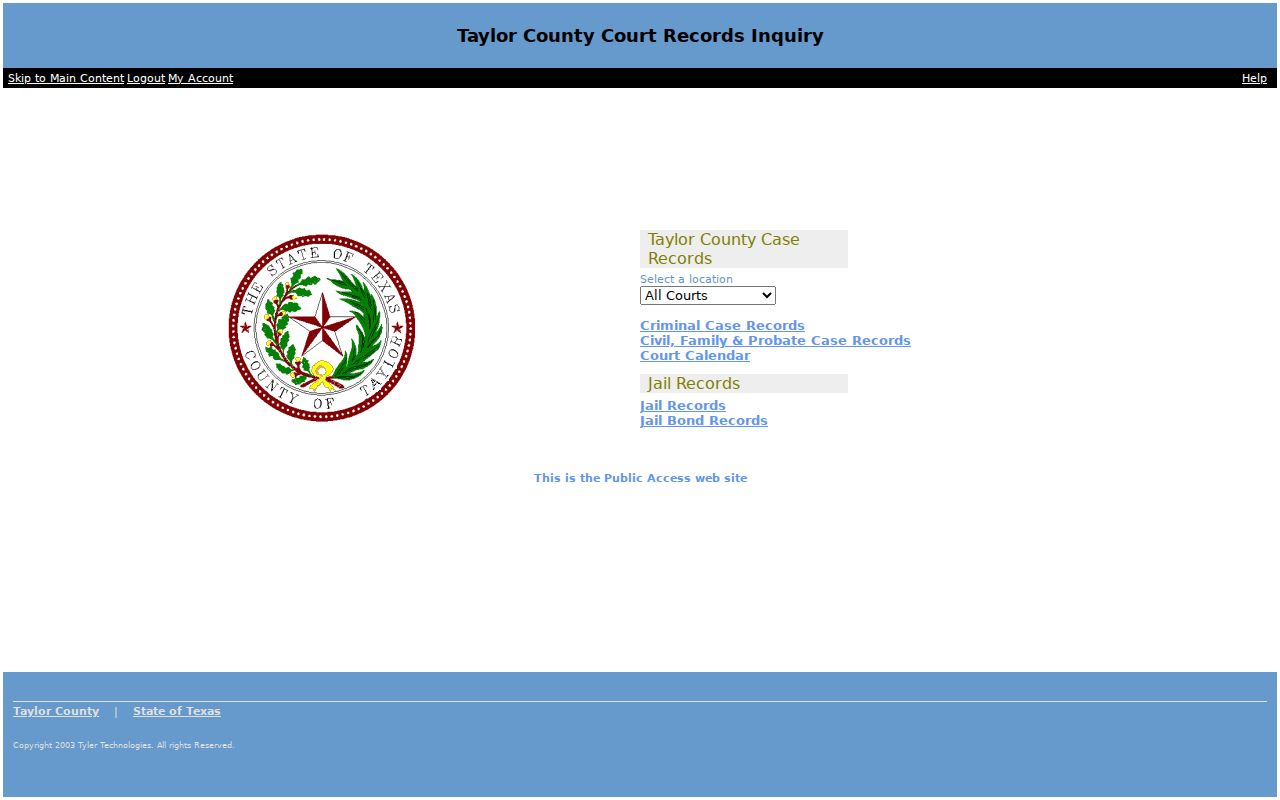
Civil searching lives in its own portal location. Criminal, calendar, jail, and bond records sit elsewhere. Select the correct location before typing a known cause number.