
How to Get Court Records
Start with Taylor County Odyssey to find a case and its docket events. Once you know what you need, ask the office that holds the filed document. District felony, district civil, and family records sit with the District Clerk. County Court at Law misdemeanor cases, county civil matters, probate, guardianship, and mental-health files all belong to the County Clerk. JP and municipal courts keep their own lower-court records.
- Identify the case number, court, and exact petition, order, judgment, or other document.
- Check the online docket, then call the clerk to confirm custody, page count, fee, and current counter.
- Submit the documented mail or in-person request. Use the civil form for district civil files.
- Pay the invoice by an accepted method. Do not assume an email, fax, or drop box accepts copy requests.
- Receive the plain or certified copy, or ask what court order is required if access is restricted.
Taylor County Civil Request Form
The civil form is short and practical. It asks for the case number if you have one, both party names, the filing year, and a callback number, with checkboxes for certified or non-certified copies. The Records Department works out the search and page total, then mails an invoice. Listing what you want beats guessing from a portal screen that returned nothing.
| Form Field | Use | Required Detail |
|---|---|---|
| Case number | Direct file match | Use when known to avoid research charge. |
| Plaintiff and defendant | Name search | Helps identify the cause when no number is supplied. |
| Year of filing | Archive scope | Narrows the clerk's search. |
| Callback number | Clerk follow-up | Used for questions and invoice handling. |
| Copy checkbox | Certification choice | Select certified or non-certified. |
Send the request to Civil Records Division, Taylor County District Clerk, 300 Oak Street, Suite 400, Abilene, Texas 79602. Questions can go to (325) 674-1316.
Types of Court Records
A Taylor County court record can be a single docket sheet or a full file. Files often hold initiating papers, service returns, motions, notices, signed orders, judgments, and appeal entries. Access depends on the court, the document, its age, and the rule that applies.
- Case summaries, docket sheets, and chronological register entries
- Petitions, complaints, indictments, answers, motions, and service returns
- Signed orders, judgments, dispositions, and appeal or transfer papers
- Public civil, criminal, family, probate, and guardianship materials
- Certified clerk copies for a formal need
Taylor County Archive Boundary
The online civil search covers district cases filed after September 1994. Anything older needs a District Clerk office search or the civil request form. Off-site material can take up to two weeks to pull. No amount of filter tweaking will pull a file outside the portal's date coverage. The Taylor County Civil Searches source spells out that boundary.
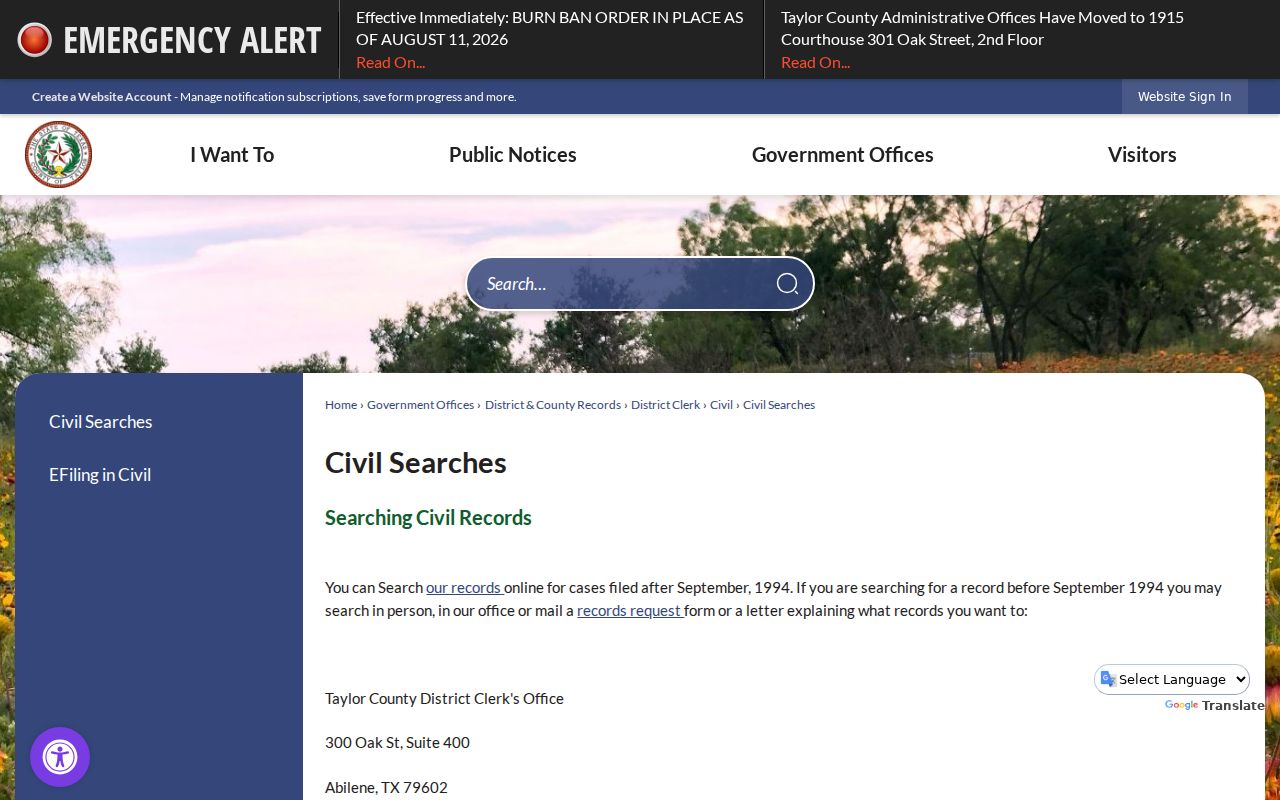
The page ties modern docket access to the mail and counter route for older case files. Note: When a Taylor County archive request has no cause number, give the filing year and each party's role in the case.
What a Court Record Contains
The docket lists events; the record holds what was filed. Start with the case header and the event list. Then match each paper you want to its title and filing date. That detail keeps the clerk from sending a similarly named document from the same cause.
| Case Number | The exact cause number assigned by the clerk. |
|---|---|
| Pleadings | Petitions, complaints, answers, motions, and other filed requests. |
| Orders & Judgments | Signed rulings and final or interim decisions. |
| Docket Sheet | The chronological index of filings, settings, clerk acts, and outcomes. |
| Exhibits | Filed attachments where public and retained, subject to access limits. |
Taylor County Docket or Document
A free case lookup gives you metadata. That means the court, cause number, filing date, status, settings, and events. The filed document is different. It holds the words and signatures behind a docket event. A certified copy, in turn, is a clerk-authenticated reproduction of that filing. Saving a page to your own device does not make it certified.
- Docket
- The event index showing how the cause moved.
- Filed document
- The petition, motion, order, judgment, return, transcript, or exhibit itself.
- Certified copy
- A reproduction authenticated by the clerk for a formal purpose.
- Transcript
- A court reporter's record, requested separately from clerk copies.
Transcripts take a separate route. Contact the assigned court or reporter; Taylor County publishes no single reporter form or rate schedule for them.
Certified Copies and Fees
The district civil and criminal pages list copies at $1 per page. Without a case number, add a $5 research fee. The criminal page prices certified and non-certified copies the same, with no separate certification surcharge named. Ask for the quote before you pay.
| Item | Amount |
|---|---|
| District civil copy | $1 per page |
| District criminal plain or certified copy | $1 per page as stated on the criminal page |
| Research without case number | $5 |
| Probate search | $5 per name |
Taylor County District Clerk
300 Oak Street, Suite 400
Abilene, TX 79602
(325) 674-1316
Taylor County Copy Payment
The civil records office totals the charges and sends an invoice. Return it with cash or a money order. The form says personal checks are not accepted, and records mail out after full payment. Skip sending cash by mail. Do that only if the clerk's current instruction and a safe delivery method are confirmed. The Taylor County criminal-copy source lays out the case-number, payment, mailing, and certification instructions.
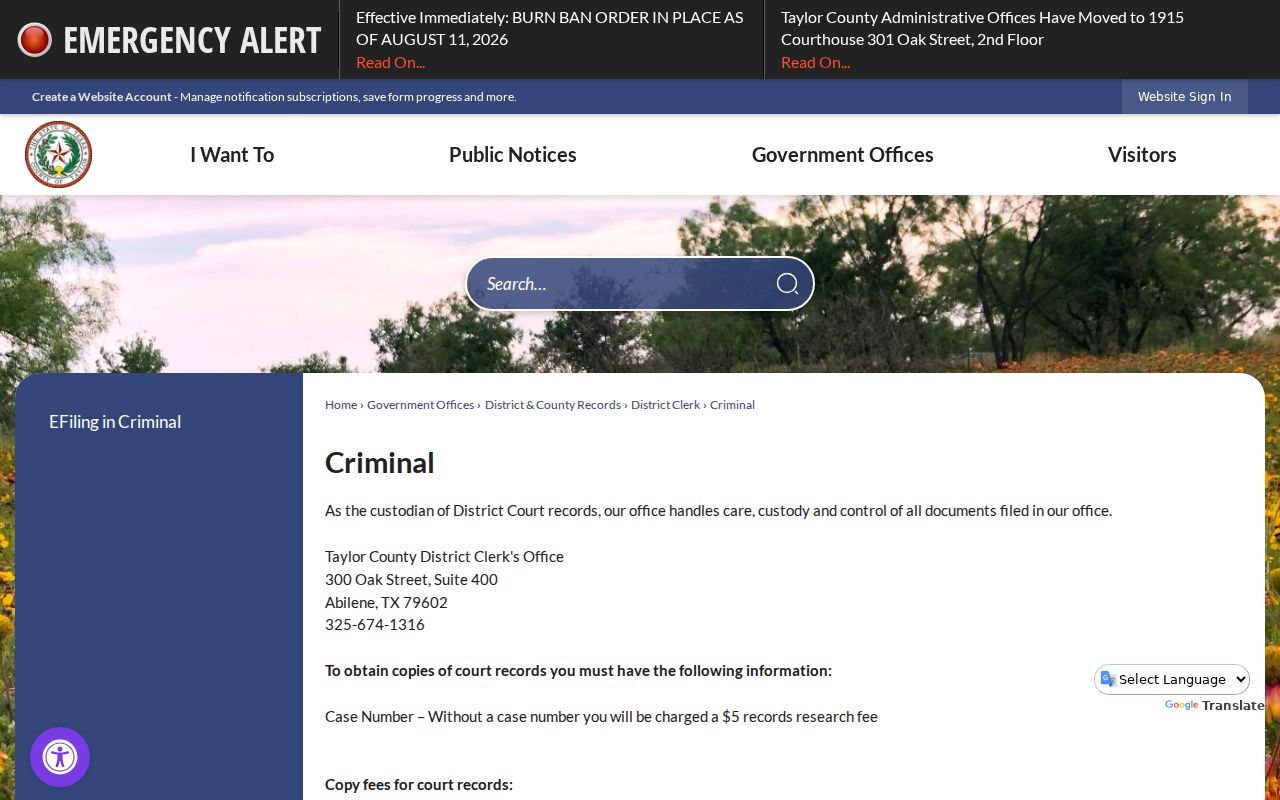
The official page points you to a direct clerk request rather than treating a portal image as the final record.
Public Access and Sealed Records
Access in Texas turns on the record type and who keeps it. Case files that are part of the court's decision-making come from the court or clerk. Rule 12 covers many judicial administrative records. The Texas Public Information Act, Government Code Chapter 552, covers non-judicial public information. Neither gets around the clerk's case-record process.
Key Rules:
Texas Judicial Branch Open Records Policy explains Rule 12 and proper request routing.
Texas Government Code Chapter 552 is the state public-information framework for non-judicial county records.
Texas Family Code Chapter 58 restricts juvenile-record access.
Taylor County Rule 12 Routing
Put the record, court, cause, date, and desired format in writing. First sort out what the item is. It may be a filed case document, a judicial administrative record, or a general county administrative record. Route it to the custodian that owns it. Rule 12 does not compel record creation. It also does not require keeping one in a requested format. The Texas Judicial Branch policy source draws these lines in full.
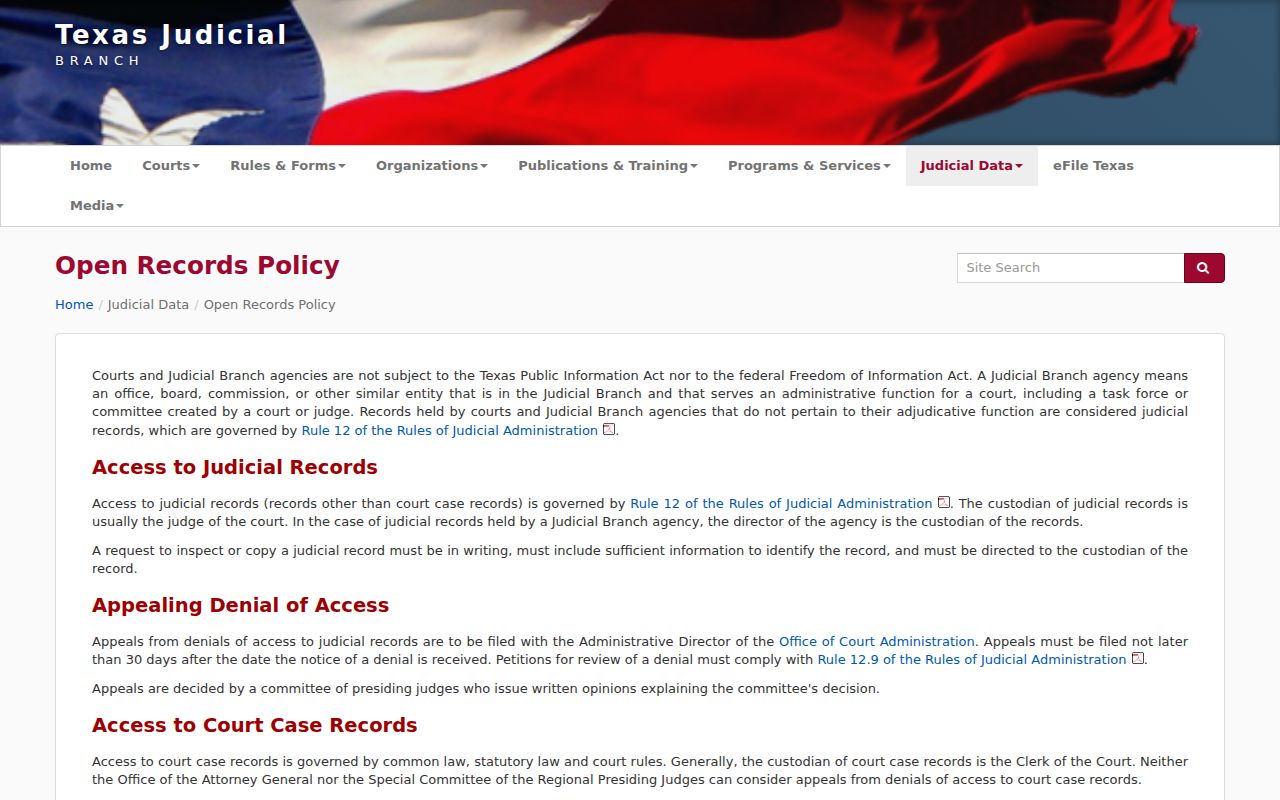
That routing guidance keeps a Taylor County request from landing on the wrong desk. Juvenile, sealed, expunged, nondisclosed, and sensitive-identifier material may be withheld or redacted. Clerk staff can explain custody, cost, and process. They cannot advise sealing, expunging, appealing, or seeking nondisclosure.
Taylor County Probate Requests
Probate requests through the County Clerk follow a separate workflow. Search by cause number or decedent name first. Then call (325) 674-1202 or email county.clerk@taylorcounty.texas.gov with the cause number and exact document titles. The clerk will supply the page count and total. Do not assume probate custody from the District Clerk's civil form.
For an in-person request, County Clerk pages list 300 Oak Street, Suite 100, Abilene. A current county alert also reports administrative offices moved to 301 Oak Street, second floor. Verify the counter before traveling. The two Oak Street buildings serve different functions. The alert does not prove that each court-record counter moved.
Probate, guardianship, and mental-health records may also involve the constitutional Taylor County Court or a County Court at Law. The public index helps identify the cause. It does not settle whether a specific filing is open. Give the County Clerk the cause number and document title. Ask whether redaction or a court order applies, and request a current fee quote. That keeps the request tied to the right file. It also avoids treating a probate index entry as the filed instrument itself.
The constitutional Taylor County Court handles probate, guardianship, mental-health commitment, and long-term commitment matters. Its office is listed at 400 Oak Street, Suite 300. The phone number is (325) 674-1235. County Courts at Law may also receive probate assignments. Confirm the named court on the docket before asking for an order, inventory, application, or judgment. Similar record types can sit in distinct court files.
County civil and misdemeanor records use another County Clerk path. Class A and B misdemeanors are assigned by surname. They generally run A-K to County Court at Law No. 1 and L-Z to No. 2. That assignment rule does not govern district civil or family causes. State the court number. Asking only for a broad criminal or civil search is not enough.
Record age changes the fulfillment plan too. Taylor County identifies September 1994 as the district civil online boundary. Older documents stored off-site may take up to two weeks after a written search request. That delay reflects archive retrieval. It is not a different access standard. Supply the cause number, filing year, party roles, and exact document title. That gives records staff the best chance to quote the right page count and return the file.
For district criminal records, address a written request to Criminal Felony Court Records and pay the full quoted amount before mailing. For district civil records, return the clerk's invoice with the accepted payment. The published channels do not establish a general email, fax, or drop-box copy process. Fax may still be used for some civil filings. Filing a document and ordering an existing court record remain separate tasks.