
How to Search the Taylor County Court Docket
Start at the Taylor County Odyssey Public Access portal. Pick the right shelf before you type anything. It splits five ways. Choose Criminal Case Records, Civil, Family and Probate Case Records, Court Calendar, Jail Records, or Jail Bond Records. The court you need comes first. District felonies, district civil cases, and family matters live with the Taylor County District Clerk. Class A and B misdemeanors, probate, and county civil work go through the Taylor County Clerk. Justice and municipal cases stay with the lower court that filed them.
Search by case or cause number whenever you can. That single key tells apart people with similar names, points to the right court, and spares you the District Clerk's $5 research fee for a civil or felony case staffers must hunt down without it. Grab the number anywhere handy. Check a citation, a court notice, a judgment, release paperwork, or an old filing. If Odyssey is down, use the official fallback channels. A missing result is never proof that no case exists.
- Identify the case level and the court named on the paper.
- Open the correct Odyssey location and use the case number first.
- Confirm the court, filing date, status, and newest docket event.
- Check Court Calendar for a setting, then confirm it with the court coordinator.
- Ask the correct clerk for a plain or certified copy when the document itself is needed.
Taylor Odyssey Has Five Locations
Think of the Odyssey landing page as a routing map. Criminal Case Records takes you to the court files. Civil, Family and Probate Case Records points the same way for those case types. Court Calendar is all about settings. Jail Records and Jail Bond Records cover custody and bond facts only. They do not show the court's full procedural history. The split matters. A jail entry is not a conviction, and a bond line is not a disposition. The official Taylor County landing page lays out these five locations clearly. You can see at a glance where each kind of record begins.
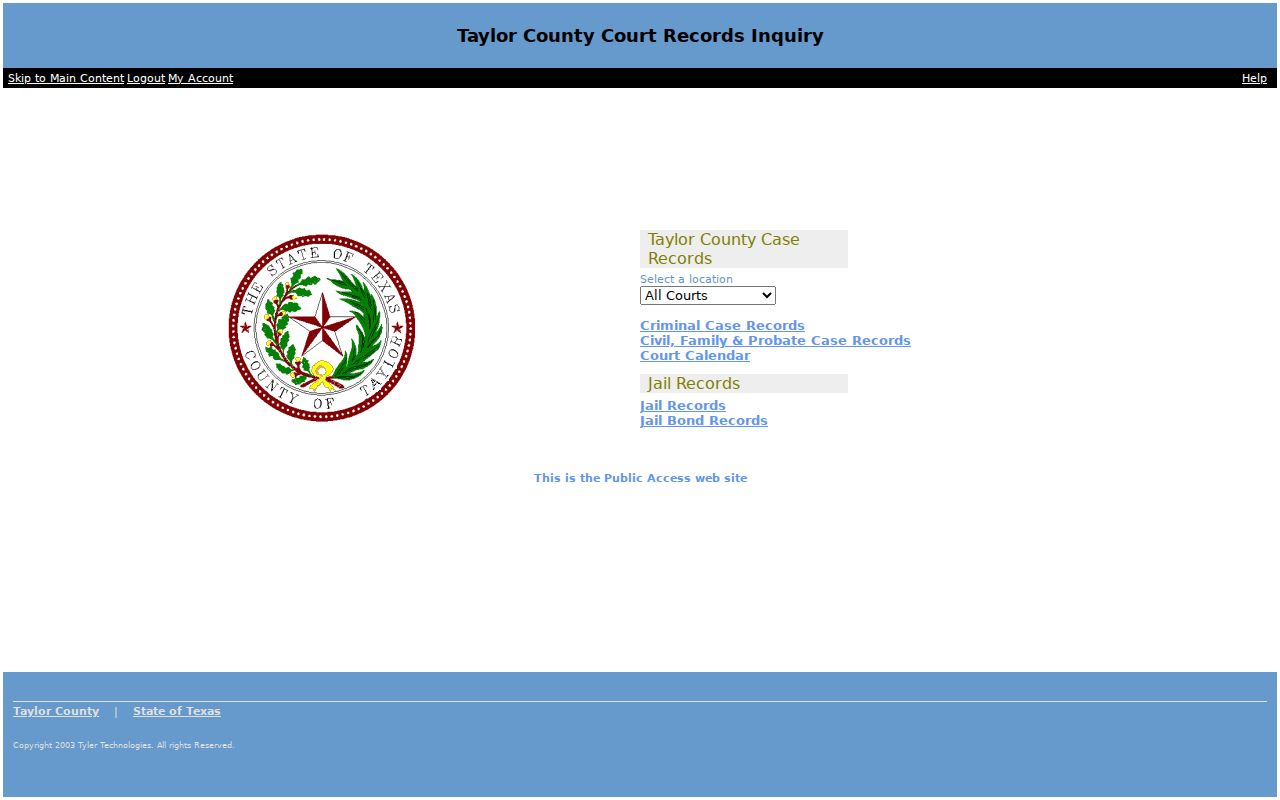
One look at the portal explains the lesson. A Taylor County court docket search works only when it starts from the record type, not from one broad name search across every location.
What a Court Docket Shows
A Taylor County court docket is a list of events, not the whole case file. Expect the case number first. Then look for the assigned court, a filing date, status, parties, charges or case type, hearings, filed motions, orders, and a disposition. Field labels on the live portal can shift, since the Odyssey form itself varies. Check the labels there. Copy sensitive details carefully, or not at all.
| Case number | The cause identifier used by the court and clerk; quote it exactly. |
|---|---|
| Parties | The names tied to a public case, subject to privacy and sealing rules. |
| Docket entries | A dated sequence of filings, notices, orders, and other events. |
| Hearing settings | The date, time, court, and purpose of a listed setting. |
| Court and judge | The assigned tribunal and judicial officer when displayed. |
| Disposition | The recorded outcome, which must be read with the final order or judgment. |
Taylor County Docket Terms
Taylor County docket labels are short for a reason. Each one means something specific. Read them in date order, and match any entry to the filed order when that order is on hand.
- Setting
- A scheduled court event, not proof that the event occurred.
- Reset
- A new date that replaces or follows an earlier setting.
- Continuance
- A court-approved postponement of a hearing or trial.
- Disposition
- The recorded result of a charge, claim, or case.
- DWOP
- Dismissal for want of prosecution in a civil matter.
Indictment, bond, plea, nonsuit, and default entries each play their own procedural role in a Taylor County docket. Treat any of them as a final judgment and you will misread the case.
Which Courts Keep Dockets
Taylor County runs a split-clerk system with several independent lower courts on top. The 42nd, 104th, and 350th District Courts take the major civil and felony criminal matters. Family law belongs to the 326th District Court. Two County Courts at Law handle Class A and B misdemeanors plus county-level civil and probate assignments. The constitutional County Court covers probate, guardianship, and mental-health cases. Below that sit five Justice of the Peace courts. The city municipal courts do the same. Each keeps its own traffic, fine-only, small-claims, and eviction dockets.
| Court | Docket Covers | Where to Search |
|---|---|---|
| District Courts | Felony, major civil, and family cases | District Clerk and Taylor Odyssey |
| County Courts at Law | Misdemeanor, county civil, and assigned probate | County Clerk and assigned court |
| Constitutional County Court | Probate, guardianship, and mental health | County Clerk |
| Justice Courts | Traffic, Class C, small claims, debt, and eviction | The issuing JP precinct |
| Municipal Courts | City ordinance and fine-only cases | The issuing city court |
Taylor County Docket Clerks
Clerk is not one office in Taylor County. The Taylor County District Clerk is Tammy Robinson's office. It holds the district felony, civil, and family records. The Taylor County Clerk, under Brandi DeRemer, holds County Court at Law misdemeanors plus county civil, probate, and guardianship records. Every Justice and Municipal Court keeps its own lower-court docket in house.
| If the paper says | Start here |
|---|---|
| 42nd, 104th, 326th, or 350th District Court | District Clerk |
| County Court at Law No. 1 or No. 2 | County Clerk |
| JP precinct or city court | That named lower court |
Get this first routing choice right and many failed searches fix themselves. A city citation may never show up in the district-court location. An older district civil file can call for a written request.
Finding Court Dates and Settings
For court dates, open the Court Calendar location on Taylor Odyssey. Match the case number first. Then match the court and the newest setting. A setting might be a docket call, arraignment, pretrial, motion hearing, trial, or something else. Resets and continuances leave older dates in the history. Check the latest line against the court coordinator's current calendar. The full Taylor County court calendar walkthrough covers online, phone, and counter checks. If a date affects your appearance, call the assigned court. Portal data can lag. The county's current office move makes confirming both time and location the smart move. Remember: a listed setting is a schedule entry. It is not proof a hearing happened or that the case ended.
Taylor County Civil Dockets Since 1994
The District Clerk puts the online cutoff for civil searches at records after September 1994. That is a hard technology line, not a hint to keep fiddling with filters. A Taylor County civil docket filed earlier may need an in-person search or the official civil search form mailed to the Civil Records Division.
The form wants the case number if you have one, plaintiff and defendant names, the filing year, a contact phone number, and whether you need a certified or non-certified copy. No case number means a $5 research fee. Copies run $1 per page. The office sends an invoice, takes cash or money order under the form instructions, and mails records after payment. Off-site older files can take up to two weeks.
Public Access to Dockets
Access to a Taylor County court docket depends on the record and who holds it. Filed case records follow court rules and clerk procedures. Administrative county records may fall under the Texas Public Information Act. Judicial records can follow Texas Rule 12. Name the court, cause number, document, date, and format you want in any request. No office has to create a record that does not exist.
Key rules:
Texas Rule 12 governs access to many judicial records and lists exemptions.
Government Code Chapter 552 is the Texas Public Information Act framework for non-judicial public information.
Family Code Chapter 58 limits public access to juvenile records.
Code of Criminal Procedure Chapter 55A governs expunction restrictions.
Restricted Taylor County Dockets
Some Taylor County court records simply stay out of public view. Juvenile, sealed, expunged, nondisclosed, family, and CPS material may be withheld. Some may show only limited details. So a Taylor County docket search can skip a case, hide a filed image, or show only part of an entry. A missing line is not proof that nothing happened. Check the spelling, case number, court, and date range first. Then ask the clerk whether an access order is required.
Texas redaction rules shield Social Security and taxpayer numbers. They also cover financial-account data, birth dates, home addresses, minor names, and similar identifiers. Public access exists for case tracking and civic understanding, not for republishing personal data. The Texas Judicial Branch open-records policy explains why the right route turns on the item you want. The key is whether it is a filed court record or an administrative one.
The Clerk and Docket Records
The Taylor County District Clerk wears many hats for district matters. The office registers and records filings. It keeps the docket, holds the court records, collects fees, and runs jury selection. Staff will explain custody, costs, and how to make a request. They cannot give legal advice. Criminal felony copy requests go through the office in person or in writing. For district civil files, bring the request to the counter or mail the county form. The County Clerk plays the matching role for misdemeanor, county civil, and probate records.
Taylor County District Clerk
300 Oak Street, Suite 400
Abilene, TX 79602
(325) 674-1316
Monday through Friday, 8:00 a.m. to 5:00 p.m.; closed noon to 1:00 p.m.
Taylor County Clerk
300 Oak Street, Suite 100
Abilene, TX 79602
(325) 674-1202
Monday through Friday, 8:00 a.m. to 4:30 p.m.; open through lunch.
re:SearchTX for Taylor County Dockets
re:SearchTX gives you Cases, Filings, Text, and Hearings search tabs, plus advanced filters, result filters, export, and saved searches for eligible records. You may need to register or use eFileTexas credentials. Keep expectations realistic. The search layer does not make Texas one complete public trial-court index, and the Texas Judicial Branch still points people to local district and county clerks, Justice Courts, and Municipal Courts for the original trial records. The official dashboard shows the statewide search choices without exposing any private case result.
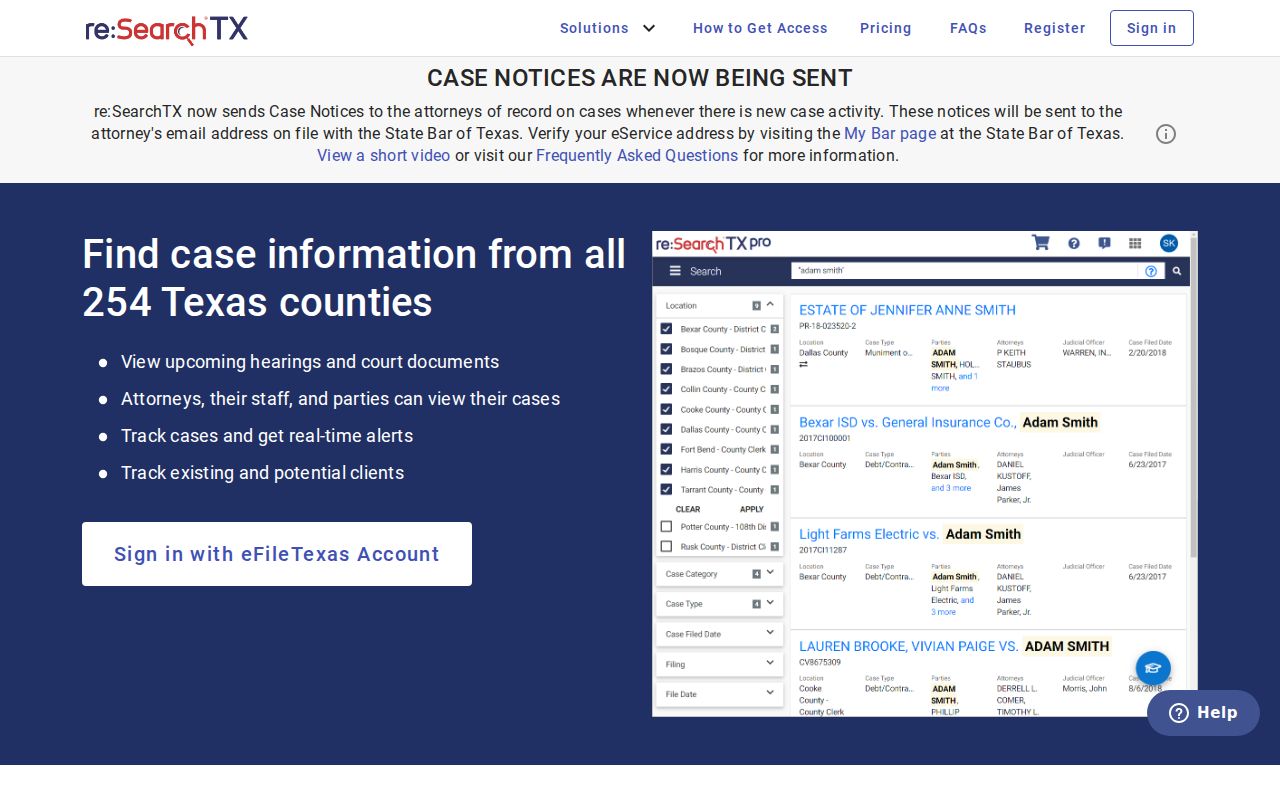
Treat the statewide layer as a second route, not a substitute. Confirm the Taylor County court, case number, filing, and hearing with the local clerk before relying on it.
Taylor County Docket Locations
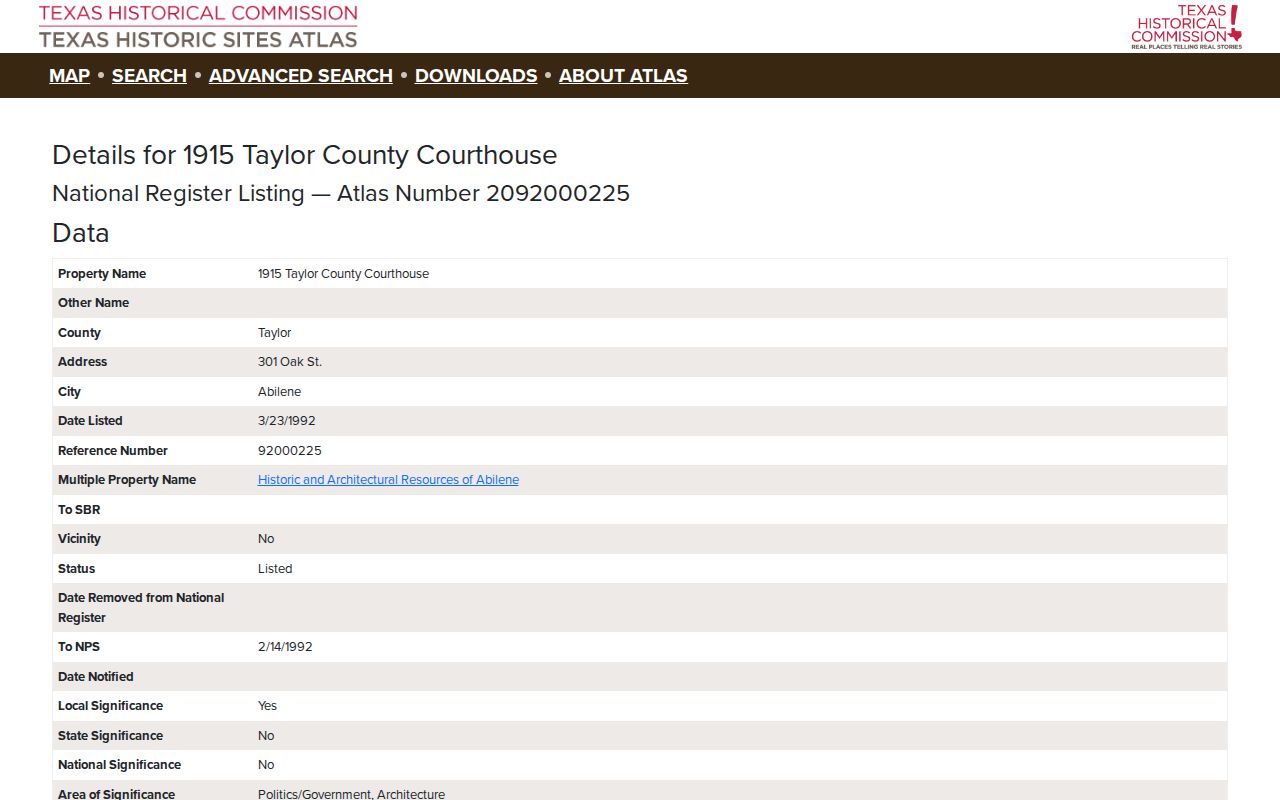
Office geography shifted in 2026. Taylor County Resolution 13-26 named the restored 1915 courthouse at 301 Oak Street as the official building. It serves as the administration and Commissioners Court home. Meanwhile, the individual court and clerk pages still list counters and courtrooms at 300 Oak Street. Those are two addresses in one active civic cluster, not one interchangeable destination.
The published suite list puts the District Clerk in Suite 400 at 300 Oak. The 42nd, 104th, 326th, and 350th District Courts sit in Suites 401 through 404. The County Clerk is in Suite 100. County Courts at Law Nos. 1 and 2 occupy Suites 500 and 501. For the constitutional County Court, the published contact is 400 Oak Street, Suite 300. So "the county courthouse" is not precise enough for a records trip. The docket, copy, hearing, and payment you need may sit at different counters inside the same Abilene court cluster.
The Texas Historical Commission Atlas records the 1915 Classical Revival courthouse and its historic status.
Call the clerk before you drive over. The county's handgun policy covers court-operation areas too. That includes both 300 Oak and the basement of 301 Oak. No single page collects the parking, device, recording, interpreter, or public-terminal rules. Ask your assigned office about those details in advance. Do not assume the administrative move moved every courtroom or records counter.
Taylor County Dockets and Copies
Know what you are asking for. A free register view, an online document image, a plain clerk copy, and a certified copy are different products. The docket gives you metadata and the procedural sequence. The filed petition, indictment, motion, order, or judgment is the document underneath it all. Certification adds the clerk's authentication for formal use.
| Request | Researched Taylor County charge | Channel |
|---|---|---|
| District civil or criminal copy | $1 per page | District Clerk counter or written request |
| Research without case number | $5 | District Clerk search request |
| Probate name search | $5 per name | County Clerk |
| Misdemeanor card payment | 2.85% increase plus $2 administrative fee | Certified Payments with bureau code 5554143 |
Ask for the total before you send payment. The civil form says cash or money order with no personal checks, and other divisions may have different current procedures.
Court Dockets by City in Taylor County
Municipal cases live at city level. Abilene offers a dedicated Municipal Court search and an upcoming-docket link. Merkel posts its own clerk, plea, and deadline instructions. Tye and Tuscola have no live search portal, so call city hall directly. Buffalo Gap also calls for a check with the issuing court. Pick the right JP fallback there too. Keep these five cities separate when you cite what you find. They are not Taylor County district or county-court dockets.
Abilene Court Docket
125,182 in the 2020 Census · dedicated Municipal Court search and docket links
Merkel Court Docket
2,471 in the 2020 Census · municipal and JP records remain distinct
Tye Court Docket
1,176 in 2020 · city contact is the verified search fallback
Tuscola Court Docket
Official city claim of 850, vintage unstated · court established by Ordinance 82
Buffalo Gap Court Docket
543 in the 2020 Census · identify the issuing court before choosing a portal
Map and Directions to the Taylor County District Clerk's Office
District, County, and County Court at Law files are kept at 300 Oak Street in downtown Abilene, a court-records building separate from the restored 1915 Taylor County Courthouse at 301 Oak Street, which now houses county administration. The District Clerk's counter is in Suite 400, with the 42nd, 104th, 326th, and 350th District Courts in Suites 401 through 404, the County Clerk in Suite 100, and County Courts at Law No. 1 and No. 2 in Suites 500 and 501 of the same building.
Taylor County District Clerk
300 Oak Street, Suite 400
Abilene, TX 79602
(325) 674-1316
Monday through Friday, 8:00 a.m. to 5:00 p.m.; closed noon to 1:00 p.m.
The county's handgun policy bars firearms from court-operation areas at both 300 Oak and the basement of the historic 301 Oak courthouse, even for license holders. Taylor County's homepage also carries an alert that administrative offices moved to 301 Oak's second floor, so confirm which building handles a given counter before a visit, since individual court and clerk pages still list 300 Oak suites. No county-wide parking, interpreter, or terminal policy is published, so call the clerk ahead of time.